
A mesonet is a network of multiple weather stations that measure meteorological conditions including wind speed and direction, temperature, humidity, atmospheric pressure, solar radiation and precipitation and transmit the data. These stations are located much closer together than traditional networks, often just a few miles to tens of miles vs. hundreds of miles. This proximity captures mesoscale weather events, which occur during a shorter timeframe and on a smaller scale, defined as being within 150 miles. The data create a high-quality representation of the environment and helps to advance the understanding of processes occurring in the atmospheric boundary layer used in real world applications for local emergency management, hyperlocal weather forecasting and research.
ARL’s Special Operations Research Division (SORD) maintains two mesonets; one for the Department of Energy (DOE) in Idaho and the other for the National Nuclear Security Administration in Nevada.

ARL mesonets
In a mesonet, the instrumentation must be carefully selected to coordinate remote collection of data from the various sensors. The data are collected into a central repository and transmitted using the internet, radio frequency communications or other means and displayed in near real-time for SORD meteorologists, emergency responders, experiment directors and site operations personnel.

Idaho
There are 35 fully automated meteorological observation stations at the Idaho National Laboratory and surrounding area, 14 of which are located within the Lab’s boundaries.
The remaining stations are sited at key locations throughout the Eastern Snake River Plain. Standard meteorological data, such as wind direction and speed, temperature, relative humidity, atmospheric pressure, solar radiation, and precipitation are measured at each Mesonet station. Data from all instruments are collected in a data logger and transmitted by radio to the SORD Idaho office every five minutes. Once archived, these data are then available for display, redistribution and analysis.
The remaining stations are sited at key locations throughout the Eastern Snake River Plain. All stations measure wind direction and speed, temperature, relative humidity, atmospheric pressure, solar radiation and precipitation. A data logger collects everything and transmits by radio to the SORD Idaho office every five minutes. Once archived, these data are then available for display, redistribution and analysis.
The Idaho mesonet is primarily comprised of 50-foot-tall towers, three tall towers that range in height from 150 to 250 ft., and two shorter towers, on at 20 foot and the other at 30-foot. The tall towers are the “primary” on-site observation stations in each of the three INL microclimate zones depicted in the Figure 4. Shorter towers are on the summit of Big Southern Butte and Craters of the Moon National Park where aesthetic restrictions permit only a 20 ft. and 30 ft. tower, respectively.

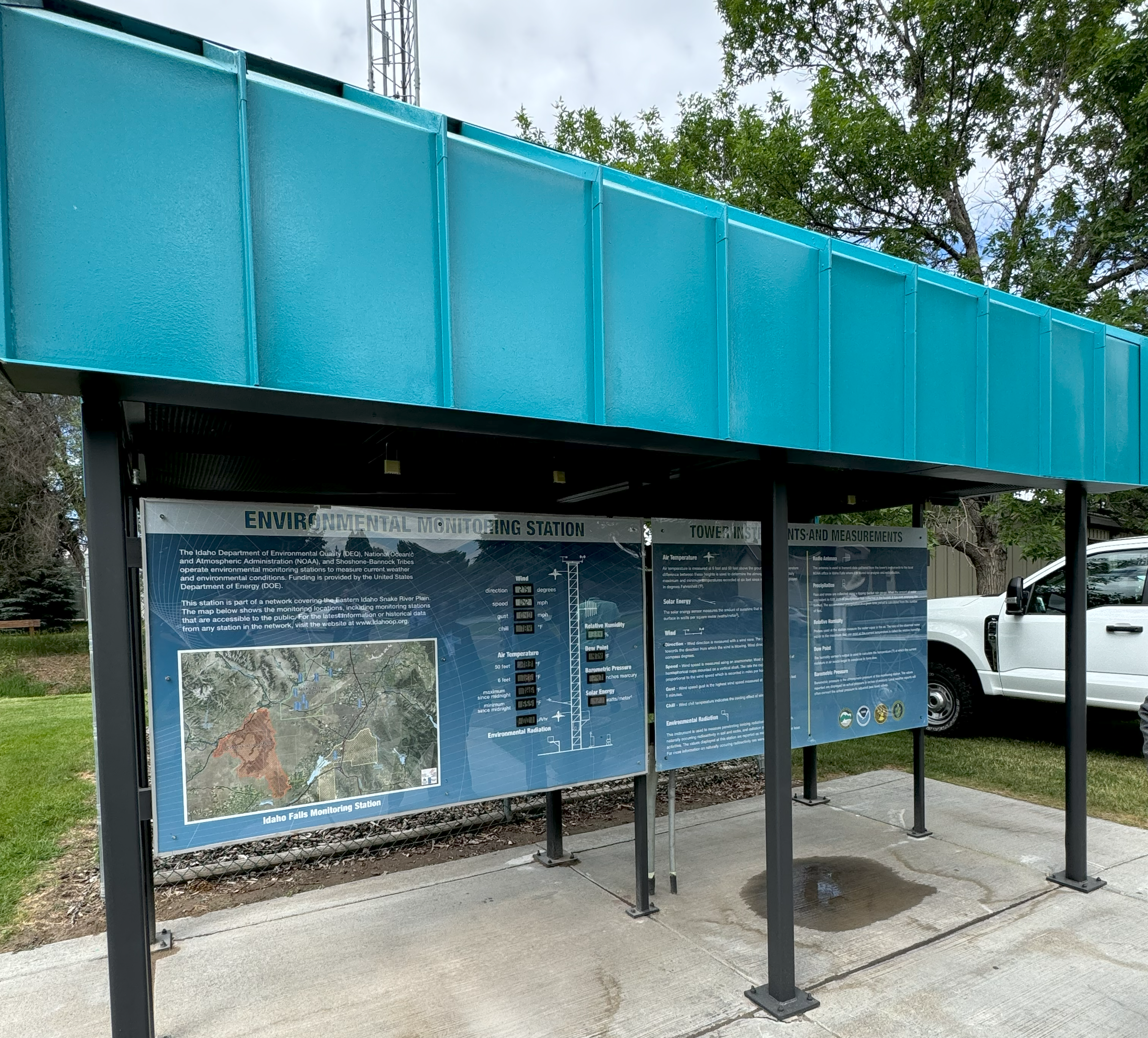
Four of the mesonet stations are Community Monitoring Stations and are sited at schools and other public places to encourage interaction with local communities and share NOAA’s weather data. These stations were developed in partnership with the Department of Energy Idaho, the State of Idaho’s Idaho National Laboratory Oversight Program, the Shoshone-Bannock Tribes, the City of Idaho Falls and the State of Idaho Transportation Department. The monitoring stations each include a fully instrumented weather tower, a walk-up shelter displaying current meteorological conditions and descriptions of everything measured.
Nevada
There are 27 fully automated meteorological observation stations in operation at the Nevada National Security Site and surrounding area, 26 are located within its boundaries. The remaining station, circled in blue, is sited at the National Nuclear Security Administration’s Office in Las Vegas, NV.
ARL’s Nevada mesonet is comprised of 33-foot-tall towers each of which collects meteorological data such as wind direction and speed, temperature and relative humidity (at two heights), atmospheric pressure, solar radiation and. Data from all instruments are collected in a data logger onsite and transmitted by radio to the SORD Nevada office every fifteen minutes. Once archived, these data are then available for display, redistribution and analysis.

In addition to the primary mesonet, SORD Nevada also operates and maintains several other observing networks, systems and capabilities to provide custom hyper-local forecasting for a range of customer needs, such as national security related research and a mobile remote-sensing capability. These additional capabilities include: a ten-station mobile trailer tower, known as a micronet, a five-sensor dedicated lightning detection network, a sodar (sensor that measures atmospheric conditions using sound waves), and a mobile upper-air balloon release capability. The micronet is deployed during special experiments conducted on the Nevada National Security Site and measures standard meteorological data, such as wind direction and speed, temperature and relative humidity (at two heights), atmospheric pressure and solar radiation. The lightning detection network is used to support safety and operations for special experiments and activities on the National Nuclear Security Site as well as in preventative and forensic modes for wildland fire mitigation and fire investigations. The sodar is used to obtain 15-minute vertical profiles of the wind to support special experiments, emergency response and aviation activities. The mobile upper-air balloon release capability is used to obtain detailed meteorological data about the vertical structure of the atmosphere, especially in the boundary layer, to support special experiments and boundary layer analysis and research.

Emergency response and meteorological notices
SORD provides a wide range of advisory and emergency response related forecasts, data, and information for the Idaho National Lab and National Nuclear Security Site. Over time, emergency response has become more formalized, and the types of meteorological information that are available to support emergency operations have become more sophisticated. ARL meteorologists now staff the Emergency Operations Center during drills and emergencies, such as wildland fires. Some of the products and services provided are:
- Wind, temperature, and atmospheric stability forecasts
- Transport and diffusion model interpretations
- Plume trajectories
- Advice on evacuation routes
- Prediction of ground level air concentrations
- Estimates of doses
- High wind advisories
- Lightning alerts
- Severe weather alerts
Additional services are provided for the safety and efficiency of construction, industrial and transportation activities at the sites. These activities require design, planning and operational support. For example, meteorological notices are routinely prepared for winds exceeding specific speeds, which may be used to warn about unsafe conditions for crane operations or significant blowing dust events. Dust can reduce visibility and HVAC efficiency and increase risks to employees working outdoors,
History of ARL’s mesonets
Idaho
The NOAA/Idaho National Laboratory Mesonet began with a single station at the Central Facilities Area in 1949. Between 1950-1970, six on-site and 16 off-site monitoring stations were added to form an expanded observational network. The number of meteorological monitoring stations continued to expand and change over the years not only to support various projects and provide meteorological data for emergency response models, but also to gain a better understanding of the climatology of the Idaho National Lab and Eastern Snake River Plain. The current mesonet configuration of 35 stations meets the needs of planners, emergency managers, scientists, engineers, operations personnel, the local National Weather Service Weather Forecast Office in Pocatello, ID and the general public.
Nevada
Originally known as the Nevada Proving Grounds and then the Nevada Test Site, ARL has had a presence on the Nevada National Security Site located about 60 miles northwest of Las Vegas, NV since 1956. SORD has supported national defense missions of the Atomic Energy Commission, the Environmental Research and Development Administration, the Department of Energy, and now the National Nuclear Security Administration, which has its roots in nuclear weapons testing from the Cold War era where 928 tests were conducted primarily underground. The early weather stations were mobile and moved around to the areas where the tests were being conducted. A fixed facility, the Yucca Flats Weather Station was established in 1956 and conducted intermittent weather observations to support the experiments. The Nevada mesonet currently consists of 27 semi-permanent stations and 10 mobile trailer stations and supports national security experiments, scientists, emergency managers, site operations, the local Weather Forecast Office in Las Vegas, NV and the general public.